

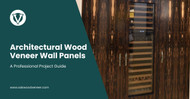
The Feature Wall: Beyond Paint and Paper
Architects and high-end designers use wood veneer wall panels to bring warmth, luxury, and a "natural rhythm" to a room. While you can buy pre-fabricated panels, many pros prefer to use flexible wood veneer sheets applied to custom-cut MDF substrates. This approach allows for total control over grain direction, ensures seamless corner transitions, and provides a level of customization that off-the-shelf products simply can't match.
1. The Power of Sequence Matching
When you are covering a 12-foot wall or an entire executive suite, you cannot simply buy random sheets of white oak veneer. To achieve a professional look, you need a Sequence Matched Set.
-
What it is: These are wood veneer sheets sliced consecutively from the same log (the flitch).
-
The Result: Because the sheets are "neighbors" from the same tree, the grain "travels" and flows from one panel to the next. It creates a visual narrative that makes the entire wall look like it was carved from a single, massive tree rather than a patchwork of different boards.
2. Choosing Your Core (The Substrate)
For architectural wall applications, we almost always recommend 1/2" or 3/4" MDF. Unlike plywood, MDF has no grain direction of its own, meaning it is perfectly flat and won't warp or "telegraph" grain patterns through the face of your veneer wood sheets.
-
The Installation Secret: Never apply veneer directly to drywall. Drywall is uneven and the moisture in the glue can cause the paper to peel. Instead, build your panels in the shop where you have a controlled environment.
-
The Z-Clip Method: Once your panels are veneered and finished, mount them to the wall using Z-clips. This creates a professional "floating" look, hides all fasteners, and allows for natural air circulation behind the panel, which is crucial for long-term stability.
3. Balancing the Panel (The Golden Rule)
If you apply veneer to only one side of an MDF panel, it will eventually bow. As the glue dries and the humidity changes, the face veneer pulls on the substrate.
-
Balanced Construction: Professional millworkers always apply a "balancer" or backer sheet to the opposite side—even if it will be hidden against the wall. This keeps the internal tension equal. At Oakwood, we can provide utility-grade backers for this exact purpose, ensuring your wall remains perfectly flat for decades.
4. Shop Tips for a Flawless Finish
Before you move to the job site, perform these two critical checks:
-
Avoid the J-Roller: We never recommend a standard J-roller for wall panels. It doesn't provide the localized pressure needed for a permanent bond. Use a specialized veneer scraper or a vacuum press to ensure 100% contact.
-
The Raking Light Test: Before the finish goes on, inspect the panels under a raking light (a light held at a sharp angle). This will reveal any specks of dust or tiny bubbles that would otherwise be hidden until the light hits the wall at the install site.
Conclusion: Partnering with the Experts
Creating architectural-grade wall panels is one of the most rewarding challenges for a shop, but it requires precision and the right materials. By focusing on sequence matching and balanced construction, you transform a simple room into a masterpiece of millwork.
At Oakwood Veneer, we act as your Off-site Veneer Department. Whether you need a sequence-matched set of Rift White Oak or custom panel layups for a 50-panel commercial lobby, our team is ready to help you scale your capabilities without the overhead.
Ready to start your next feature wall? Explore our sequence-matched inventory or call our expert sales team at 800-426-6018 to discuss your elevations.