

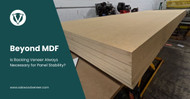
One of the most debated topics in any professional shop is "balancing." You’ve got your beautiful wood veneer sheets ready to go on the face of a panel, but do you really need to stick something on the back, too?
A lot of guys think backing (or "balancing") is just an extra cost, especially if the back of the panel is hidden inside a cabinet. But if you want to avoid a "potato chip" warp that ruins your project, you need to understand the physics of veneer panels.
The Golden Rule: The Balanced Construction
In the world of high-end millwork, we live by a simple rule: What you do to one side, you must do to the other. Wood is constantly moving. Even though wood veneer sheets are thin, they pack a lot of tension. When the glue dries and the humidity changes, that veneer is going to pull. If there’s nothing on the other side pulling back, your flat MDF or particleboard core is going to bow.
Why MDF is the Standard (But Not Perfect)
We love MDF and industrial particleboard because they don’t have grain, which makes them way more stable than plywood. But they aren't magic. Even a 3/4" sheet of MDF will bend if you only veneer one side. The moisture in the glue expands the face, and then as it dries, the fibers shrink and pull the board into a curve.
Watch: How to Apply Wood Veneer to MDF
Before you get into balancing your panels, you need to see the right way to get that first sheet down. In this video, Jay from Oakwood Veneer walks through the application process on MDF using contact cement.
Shop Notes from the Video:
-
Glue Coverage [00:02:11]: Jay emphasizes 100% coverage on both the veneer and the substrate. If you have dry spots, you're going to get bubbles.
-
The "Arm Test" [00:04:21]: A great trick to see if the contact cement is ready: if it pulls at the hair on your arm, it's not dry enough yet.
-
Avoid the J-Roller [00:06:42]: Jay explains why a standard J-roller is actually a bad choice for veneer. It doesn't apply enough localized pressure. He recommends a scraper or a veneer hammer instead.
When Can You Skip the Backer?
I’ll be honest with you—there are a few times you can get away without a backer, but you’re playing with fire.
-
Thick, Heavy Substrates: If you’re veneering a very small area on a very thick, heavy base (like a 1.5" thick mantle), the sheer mass of the wood might resist the pull.
-
Mechanical Fastening: If the panel is going to be screwed down tight to a steel frame or a solid wall where it physically can't move, you might get away with it.
-
PSA (Peel and Stick): Since PSA doesn't use "wet" glue, it doesn't introduce as much moisture, which can sometimes result in less immediate bowing. But for long-term veneer wood sheets stability, balancing is still the pro move.
Choosing Your Backer: You Have Options
You don't always have to use a matching piece of white oak veneer on the back if nobody is going to see it. Here are the shop-standard ways to balance a panel:
-
The Matching Backer: You use the same species and thickness on both sides. This is the gold standard for high-end furniture and veneer wall panels.
-
The "Cabinet Liner" (Utility Backer): You use a cheaper species (like maple or poplar) or a specialized phenolic backing sheet. It provides the same "pull" as the face veneer but saves you money.
-
The Balancing Sheet: Some shops use a heavy kraft paper or a "poly-back" sheet. It’s better than nothing, but it’s not as strong as a wood backer.
Shop Tips for Stability
1. Watch the Grain Direction
If you’re using a wood backer, make sure the grain runs the same way as your face veneer. If you cross the grain (like plywood), you’re creating a much stiffer panel, but you’re also inviting more tension if things get humid.
2. Check the Light
Just like we discussed in the flattening guide, use that raking light to check your panels after they come out of the press. You want zero glare so you can see if the panel is perfectly flat or if it’s starting to take a set. If it’s bowing, you might need a heavier backer next time.
3. Edge Banding Matters
Don't forget the edges. Applying edge banding before or after the face veneer can change how the panel moves. Most pros apply the edge banding first, then the veneer, to "lock" everything in.
The Bottom Line
Is backing always necessary? If you care about the panel staying flat for twenty years, the answer is yes. Whether you're doing wood veneer for cabinets or big architectural veneer panels, a balanced sheet is the only way to guarantee a professional result that won't warp on the customer.