

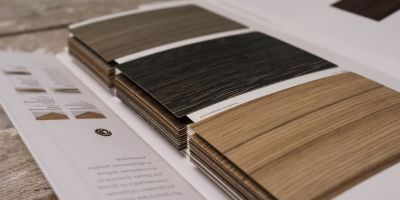
Specifying veneer for high-end casework isn't just about picking a wood color—it comes down to cut geometry, grain behavior, and visual consistency across wall runs. Slicing the exact same log at a different angle yields a completely different architectural profile.
Choosing between rift and quarter sawn white oak, exotic burls, or rustic character woods dictates your finishing prep, layout sequence, and job cost. Here is a bench-side guide to navigating grain cuts and selecting specialty face veneers.
1. Cut Geometry: Plain Sliced vs. Quarter Sawn vs. Rift Sawn
How a log meets the slicer knife determines whether your panels feature bold cathedral arches or razor-straight vertical lines.
- Quarter Sawn (White Oak & Walnut): The log is quartered and sliced perpendicular to the annual growth rings (90∘). In white oak quarter sawn flitches, this exposes medullary rays, creating dramatic "ray fleck" flakes across the sheet. In quarter sawn walnut, it produces a tight, parallel grain with subtle chatoyancy.
- Rift Sawn (White Oak): The log is sliced at a slight angle (15∘ off perpendicular) to bypass the medullary rays. This yields a pencil-straight, vertical grain profile without ray flecks. It is the premier choice when continuous linear symmetry is required across multi-panel wall runs.
- Plain Sliced (Flat Cut): Sliced parallel to the log center. Yields classic, flowing cathedral grain patterns typical of standard cherry veneer and red oak veneer sheets.
2. Specialty & Character Species Selection
When a project calls for distinct character beyond standard grain cuts, these specialty species deliver maximum visual impact:
- Birds Eye Maple Wood Veneer & White Maple Veneer: Featuring tiny, swirling eye-like dots packed into dense white maple, this figure reflects light dynamically under clear coats. Because white wood veneer options like maple have tight, closed pores, they sand down glass-smooth with minimal finishing prep.
- Knotty Alder Wood Veneer: Packed with sound, tight knots and swirling grain, knotty alder brings rustic, warm texture to mountain modern cabinetry and custom door builds without the structural instability of rotten knots.
- Vertical Grain Douglas Fir Veneer: A favorite for modern architectural interiors, offering crisp, ultra-straight vertical line patterns with warm fir undertones.
- Exotics & Distinctive Tones (Wenge & Ash): Wenge colour brings deep, near-black cocoa striping for high-contrast modern accents. For natural edge character, ash waney edge flitches retain natural log contours along panel borders.
- Solid Tones (Black Wood Veneer): For modern retail displays or sleek shadow gaps, black veneer sheets (dyed solid wood faces) provide uniform dark tones without masking natural wood texture under thick paint.
Specifiers' Species & Cut Matrix
|
Material & Cut |
Grain Alignment |
Visual Profile |
Finishing Behavior |
Ideal Architectural Use |
|
Rift White Oak |
Pencil-straight linear |
Clean, vertical lines; zero ray fleck |
Takes light, raw-look clear coats evenly |
Modern wall paneling, continuous cabinet runs |
|
Quartersawn Oak |
Vertical with flake |
Prominent medullary ray flecks |
Ray flecks resist stain slightly, creating depth |
Mission/Craftsman furniture, high-end millwork |
|
Quarter Sawn Walnut |
Parallel linear |
Rich dark brown, fine grain lines |
Deepens dramatically under oil/conversion varnish |
Executive boardrooms, high-end residential accents |
|
Birds Eye Maple |
Swirling eye clusters |
Iridescent, dense, figure-rich |
Closed-pore; requires zero grain filler |
Custom furniture tops, accent panels, instrument faces |
|
Knotty Alder |
Wild, rustic figure |
Pin knots, open character, warm tan |
Accepts wiping stains exceptionally well |
Rustic modern cabinetry, interior passage doors |
|
Black Veneer Sheets |
Uniform/Engineered |
Solid dark black with real wood texture |
Eliminates the need for heavy black lacquers |
Shadow reveals, modern retail fixtures, inset channels |
Step-by-Step: Specifying and Matching Flitches
To keep grain alignment tight across custom room layouts, follow this workflow when ordering architectural flitches:
1.Verify Blueprint Callouts: Confirm Cut Angle Specs.
Check whether architectural plans specify white oak veneers as rift, quarter sawn, or plain sliced. Mixing rift and quarter sawn sheets on the same wall run causes noticeable visual clashes under lighting.
2.Order Consecutive Flitches: Match Sequence Numbers.
Order sequenced sheets from the same log bundle. Verify that factory bundle tags run sequentially so your shop crew can press and install panels in numerical order.
3.Lay Out Panel Joints: Select the Right Joint Match.
Choose your face layup method: use Book Match for symmetrical cathedral mirrors, or Slip Match for rift and quarter sawn runs to maintain a continuous, non-repeating vertical rhythm.
Shop Tip for Ray Fleck Control: If a client wants the stability of quarter-sawn oak but dislikes heavy ray fleck patterns, specify Rift Sawn White Oak. It delivers the exact same dimensional stability and linear grain without the fleck.
The Shop Bottom Line
Mastering cut angles and species characteristics prevents spec mismatches and eliminates material waste on match day. By selecting rift sawn for modern linear precision, quarter sawn for classic fleck, or specialty figures like birdseye maple and knotty alder for custom accents, your shop delivers predictable, architectural-grade results on every build.