

When you're building out a commercial millwork package or a custom residential layout, picking the face material isn't just about showing the client a stain sample. It comes down to how that material behaves in the press, how it reacts in the spray booth, and how it holds up to daily wear on the job site.
Specifying an open-pored wood when a client wants a dead-flat satin paint job wastes hours in booth prep. On the flip side, putting a delicate, light-absorbing wood into a high-abuse commercial environment guarantees a callback.
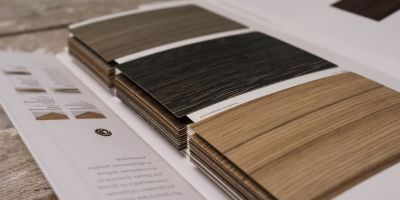
To keep your builds profitable and your finish room moving, here is a side-by-side technical guide comparing four essential face options—White Oak, Walnut, Hard Rock Maple, and Paintable Phenolic—based on pore structure, finishing behavior, and real-world durability.
1. Pore Structure: Tactile Grain vs. Glass-Smooth Surfaces
Wood anatomy dictates how much work your finishing crew has to do before a panel leaves the bench. The primary mechanical distinction on the floor is open-pore vs. closed-pore structure.
Open-Pore (White Oak)
White Oak features deep, pronounced vascular channels running down the length of the grain.
- Tactile Texture: If a project calls for a tactile, organic, or wire-brushed feel where you can physically run your hand across the wood and feel the grain structure, White Oak is the answer.
- Finishing Impact: Clear topcoats will sink slightly into those natural grain valleys. If a client wants a dead-flat glass finish on an open-pored species, your shop is stuck applying high-build sealers or pore fillers to level the face.
Closed-Pore (Hard Rock Maple)
Hard Rock Maple’s pores are tiny, dense, and tightly packed together.
- Glass-Smooth Surface: Maple sands down dead-flat with minimal effort. There are no deep grain valleys to trap dust or drink up excess finish.
- Finishing Impact: It takes clear coats uniformly without requiring pore filling, making it the ideal choice when a smooth, clean, non-distracting surface is required.
2. Finish Strategy: Natural Timber vs. Engineered Applied Finishes
Knowing when to let natural timber grain shine and when to deploy an engineered barrier sheet saves material capital and prevents callbacks.
Natural & Stained Finishes (Walnut & White Oak)
- Walnut: Prized for its natural optical depth (chatoyancy) and rich chocolate tones. It absorbs light, making large spaces feel warm and high-end. It performs best under clear, non-ambering conversion varnishes that let the organic cathedral movement do the heavy lifting.
- White Oak: Exceptional for neutral, modern organic palettes. Whether rift-cut for clean vertical lines or quarter-sawn for subtle ray flecks, it takes light stains and raw-look clear coats predictably.
Solid Color & Paint-Grade Finishes (Paintable Phenolic)
- The Golden Rule: Never waste money burying real wood face veneer under pigmented paint or primer. Real wood expands, contracts, and swells under moisture, leading to grain checking and hairline cracks in the paint film.
- The Phenolic Advantage: For painted casework, swap wood face sheets for Paintable Phenolic. The resin-impregnated backing creates a 100% non-porous barrier that blocks glue bleed-through from below and stops wet primer from swelling wood fibers above. You get a glass-smooth paint surface with zero grain ghosting.
Master Species & Material Comparison Matrix
Use this floor guide to quickly map your project specs to the correct face material:
|
Material |
Pore Structure |
Primary Visual Profile |
Finishing Strategy |
Best Applications |
|
White Oak |
Open Pore (Deep, tactile channels) |
Pale wheat to cool tan; clean linear lines (Rift) or cathedrals |
Dead-flat water-borne acrylics or non-yellowing sealers |
Minimalist cabinetry, bright wall cladding, commercial reception runs |
|
Walnut |
Semi-Open Pore (Fluid grain movement) |
Rich chocolate brown, dark cocoa, amber highlights |
Clear topcoats (conversion varnish/poly) to build grain depth |
Executive boardroom tables, luxury residential accents, mid-century furniture |
|
Maple |
Closed Pore (Tight, dense structure) |
Pale cream to clean white; subtle, uniform grain |
Clear non-yellowing topcoats; avoid heavy wiping stains |
High-traffic millwork, custom closet runs, healthcare cabinets, drawer boxes |
|
Paintable Phenolic |
Non-Porous (Engineered resin face) |
Glass-smooth, uniform, zero wood grain |
Spray-applied pigmented lacquers, conversion varnishes, or latex paint |
Flawless painted cabinetry, inset slab doors, refacing old cabinet frames |
Floor Rules: Matching the Face to Your Substrate
Even the best face material will fail if it’s pressed to the wrong core. Follow these basic shop rules during layup:
- MDF (Medium Density Fiberboard): The ultimate substrate for dead-flat panel runs. Pair MDF with Paintable Phenolic for painted builds or Rift White Oak / Walnut for seamless architectural wall paneling where zero core telegraphing is allowed.
- Cabinet-Grade Plywood / Baltic Birch: Best for structural builds, cabinet boxes, and heavy-use shelving. Pair with Hard Rock Maple or White Oak when screw-holding strength and edge durability are critical.
- Particleboard / Core Stock: Ideal for large, cost-sensitive commercial casework runs. Ensure you choose pre-assembled 2-ply wood-on-wood or paper-backed sheets to bridge minor particle voids in the core face.
The Shop Bottom Line
Good craftsmanship starts in the estimating phase. By matching the right face material to the project goal up front—using White Oak for tactile neutrality, Walnut for rich luxury, Maple for bulletproof utility, and Paintable Phenolic for flawless painted finishes—you keep your finish room moving fast and eliminate expensive job-site callbacks.