


If you’ve ever walked through a commercial office lobby or a high-end hotel boardroom a year after handover and noticed hairline cracks, warping, or popped joints in the architectural millwork, you’re looking at a failure of physics—not craftsmanship.
Architects and interior designers often default to specifying thick, 1/8" solid sawn lumber planks because they instinctively associate thickness with durability and luxury. But when it comes to engineered commercial interiors, that instinct is exactly backward. On a modern job site, a standard 1/42" raw face wood veneer sheet will outperform an 1/8" sawn sheet almost every single time.
To understand why, we have to look at what happens to wood structure when the modern building environment goes to work on it.
The Problem with Commercial Climate Control (HVAC Cycling)
In a residential setting, humidity shifts are gradual. In a massive commercial environment, the climate is entirely artificial and notoriously violent. Commercial HVAC systems are designed for occupancy loads, meaning they cycle aggressively.
Over a single weekend, a corporate office tower might shut down its main climate units, allowing humidity to spike. On Monday morning, the system kicks back on, rapidly dropping the relative humidity (RH) to bone-dry levels.
Wood is fundamentally a bundle of straw-like cells that absorb and release moisture. When the air dries out, those cells shrink. When the air gets humid, they expand.
The Physics of the Pull: 1/8" vs. 1/42"
Here is where the math catches up to you. An 1/8" thick sawn piece of wood still retains the internal structural memory and mass of a solid plank. When it experiences a sudden humidity drop, it exerts an immense amount of physical force as it tries to cup or shrink.
If that 1/8" piece is glued down to a stable substrate like MDF or particleboard, the wood is going to fight the glue line. Because the wood has so much mass and internal tension, the wood usually wins. The result? The wood splits down the grain, or it pulls away from the core entirely, creating ugly bubbles and delamination.
Now, look at a 1/42" thick slice of wood. At roughly 0.023 inches thick, the wood has been relieved of its internal structural mass. It possesses almost no independent "pulling power."
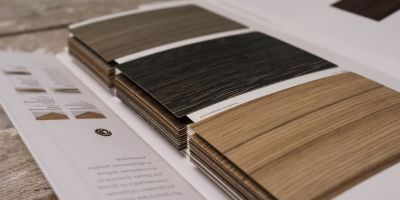
When you permanently bond premium face wood veneers like Black Walnut Wood Veneer, Zebrano Veneer, Koa Wood Veneer, or others to a balanced engineered substrate, the substrate completely controls the movement. The wood is thin enough to flex and stabilize perfectly alongside the core material during rapid HVAC cycles. You get all the warmth, grain character, and prestige of a premium species without any of the structural headaches.
In Summary: Designing for the Long Haul
When writing your project specs for corporate boardrooms or high-traffic hospitality walls, specifying the right material foundation is the difference between a lifetime installation and an expensive callback. Choosing high-quality Wood Veneer Sheets ensures that your architectural elements remain perfectly flat, uniform, and stable through decades of seasonal changes and aggressive climate control cycling.
If you're currently drafting a commercial submittal or have technical questions about balancing face veneers for large-scale wall panels, our team is here to help shop-test your layout. Contact us today to discuss your project specifications, request samples, or get a competitive quote on premium, architectural-grade Wood Veneer Panels.