


In commercial millwork estimating, there is a razor-thin line between a profitable project and a total bath. Bid too high because you padded your numbers with a generic, bloated waste factor, and the job goes to the shop down the street. Bid too low because you forgot how much yield you lose when sequence-matching a rare burl or exotic species, and you’ll end up paying out of pocket just to finish the installation.
Estimating for large-scale wall panels, corporate casework, or blueprint-matched boardrooms isn't like counting sheets of drywall. You aren’t just measuring raw square footage—you are estimating grain flow, sequence integrity, and unavoidable shop floor drops.
If you want to keep your bids competitive and your margins safe, you need a repeatable system for dialing in your material takeoffs. Let’s break down how to calculate your true yield.
1. The Core Calculation: Net vs. Gross Square Footage
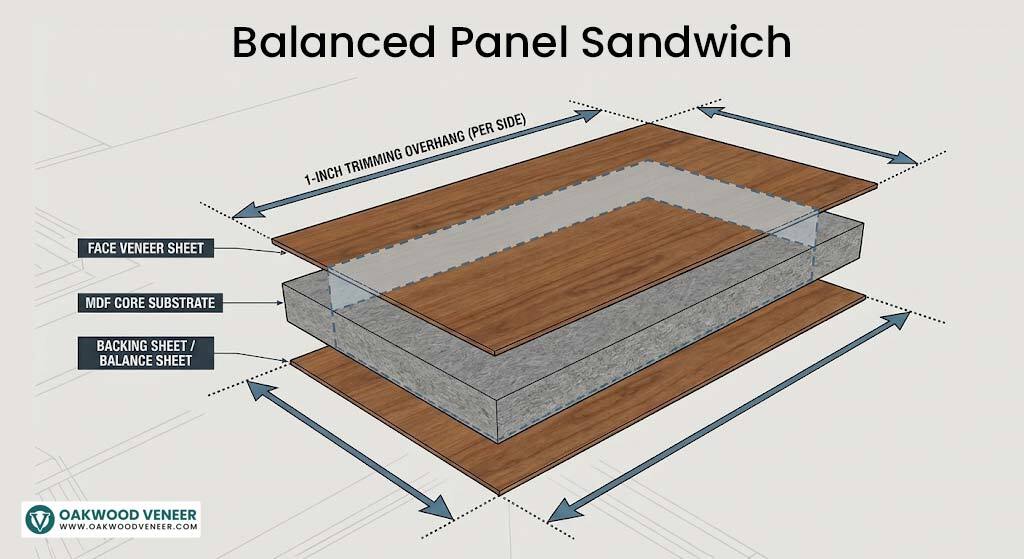
Every takeoff starts with the net square footage (the actual visible surface area of the finished architectural panels). But your net number is never what you buy.
To find your gross material requirement, you must account for trimming, sequencing, and balancing.
- The Balancing Sheet Factor: Never forget that a high-end architectural panel is a balanced sandwich. If you put a premium face wood veneer sheet on the front of an MDF core, you must apply a backing sheet to the reverse side to prevent the panel from warping. That means your core square footage automatically doubles the total amount of backing material required for the job.
- The Trimming Margin: Raw flitches or clipped sheets need a minimum of 1/2" to 1" of extra material on all four sides for final panel trimming after press-ing.
2. The Danger Zone: Calculating Waste Factors by Species and Match
Applying a flat 15% or 20% waste factor across the board is the fastest way to blow up a commercial bid. Your waste factor must adapt to the type of wood and the layout specification:
- Plain Sliced or Rift Sawn Domestics (White Oak Veneer, Walnut, Maple): For standard running matches on flat panels, a 15% to 20% waste factor is generally safe. The grain is predictable, and your drops can often be reused on smaller casework components or kick plates.
- Exotics and Crotch Woods: When dealing with highly irregular grain boundaries or narrow flitches, your waste factor should instantly jump to 30% or 40%.
- Burls: Burls are a completely different animal. Because they are harvested in smaller, irregular shapes and often have natural voids, splits, or defect inclusions that must be clipped out on the veneer saw, you should estimate a minimum of 40% to 50% waste to ensure you have enough usable material to complete the sequence.
3. Tracking the "Sequence Drop"
The biggest trap for estimators is failing to map out sequence drops. If a project specification calls for a continuous sequence-matched wall that is 9 feet tall, and you buy standard 10-foot sheets, you have a 1-foot drop on every single sheet.
Because the grain must match perfectly from panel to panel across the wall, you cannot take that 1-foot drop from Sheet A and splice it into the middle of the wall sequence. It becomes "unusable sequence waste."
When performing your takeoff, sketch out the panel layout against the physical dimensions of the sheets available in the warehouse. If your layout leaves random, un-sequenced drops, those drops must be figured into your material cost as waste, even if you save them in the shop rack for a future project.
In Summary: Protect Your Margins on Match Day
Winning the bid isn't just about turning in the lowest number; it’s about turning in the smartest number. By meticulously calculating your sequence drops, trimming margins, and species-specific waste factors, you can submit sharp, aggressive bids that protect your shop’s bottom line.
Accurate estimating requires knowing exactly what materials are sitting in the warehouse before you hit submit. When you are pricing out your next large-scale commercial project, we can help you verify flitch availability, sequence lengths, and yields for our premium Wood Veneer Sheets. Contact us today to discuss your project layouts, run through your material takeoffs, or get an accurate wholesale quote on your architectural-grade Wood Veneer Panels.