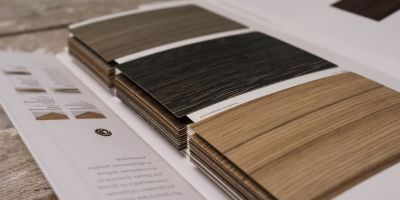

Commercial millwork estimators face a recurring dilemma during the bidding phase of corporate office build-outs. An architect’s specification requires auxiliary millwork, custom receptionist desks, or perimeter wall panels to seamlessly match the proprietary contract finishes of major corporate furniture manufacturers.
If you attempt to source matching pre-finished components directly from the furniture OEM, the markup will destroy your project margin. Alternatively, attempting to manually stain plain sliced walnut or oak to match a highly engineered, deeply saturated dark finish like Teknion Ebony on the shop floor invites color-matching callbacks and labor overruns.
The solution relies on upstream material sourcing. By utilizing engineered, reconstituted, or dyed real wood veneer sheets, estimators can accurately match proprietary contract colors while keeping production costs inside standard commercial limits.
The Matching Challenge: Why Traditional Staining Fails
Corporate furniture giants achieve finishes like Teknion Ebony through highly controlled, industrial multi-step processes. They often use reconstituted or dyed veneers coated with UV-catalyzed polyesters or high-solids conversion varnishes.
When a custom shop tries to match this by applying a dark wiping stain to standard raw wood flitches, two problems occur:
- Catastrophic Grain Variations: Natural wood species contain sapwood, heartwood, and unpredictable density changes. A dark stain will look muddy in soft grain pockets and fail to penetrate hard summerwood rings, contrasting with the ultra-uniform look of corporate contract furniture.
- Metamerism (Color Shifting): A custom stain mix may match the OEM furniture under the shop's fluorescent lights but shift to an entirely different undertone (like an accidental olive green or deep purple) once installed under 3000K corporate LED systems.
Strategic Sourcing Alternatives for Estimators
To replicate a sleek, uniform corporate aesthetic without the finishing room variables, estimators should specify one of two engineered veneer categories.
1. Reconstituted (Engineered) Wood Veneers
Reconstituted veneers are sliced from fast-growing, sustainable hardwood logs (typically poplar or ayous), dyed in bulk vats, stacked into engineered blocks, and re-sliced at precise angles.
- The Match Value: This process creates an completely predictable grain pattern and exact color uniformity across hundreds of sheets. To match a linear, high-contrast look like a proprietary dark ebony, a quarter-cut reconstituted ebony veneer delivers the exact parallel striping and grain repetition of factory contract furniture without any sorting labor.
2. Vat-Dyed Natural Wood Veneers
Unlike surface stains, dyed veneers are real, natural wood sheets (often figured maple, anegre, or walnut) that undergo a pressure-dyeing process where water-soluble dyes penetrate the entire thickness of the cell walls.
- The Match Value: If the corporate specification requires a dark, solid tone that still showcases natural cathedral grain or organic movement, a vat-dyed black or dark charcoal veneer ensures consistency. Because the dye is uniform through the sheet, you can sand the surface without clipping through a thin layer of stain.
Blueprint for Estimating and Sourcing a Color Match
To guarantee a passing submittal on a proprietary match package, follow this specific process during the estimating phase:
1.Obtain the Factory Control Master: Secure an OEM physical control sample.
Never estimate a match based on a digital PDF or website photograph. Secure an actual physical finish chip of the target scheme (e.g., an authentic Teknion Ebony laminate or wood sample) to serve as your shop’s master control unit.
2.Determine Backer and Cut Strategy: Select Reconstituted vs. Dyed sheet stock.
Choose a paper-backed or wood-on-wood engineered sheet that mirrors the grain orientation of the control chip. For modern contract finishes, a quarter-cut grain profile is almost always specified over flat-cut cathedrals to maintain a clean linear look.
3.Generate the Two-Step Submittal Match: Produce raw and clear-coated submittal steps.
Prepare a stepped submittal sample for the architectural team. Leave one half of the backed veneer sheet completely raw to show the base material quality, and apply your shop's exact clear coat (such as a dead-flat 5-sheen conversion varnish) to the other half to prove the wet-out color match.
4.Perform a Visual Lighting Assessment:Verify color under actual job site lighting.
Evaluate the submittal next to the OEM factory sample under three distinct light sources: direct daylight, 4000K cool white, and 3000K warm LED. This step ensures that the dyed veneer fibers react identically to the factory finish across different color temperatures.
Estimator Pro Tip: When utilizing reconstituted or dyed veneers to match proprietary finishes, always buy the entire project requirement from a single production run. While engineered veneers are exceptionally consistent, minor color variations can occur between separate factory dye vats. Ordering your total sheet count plus 15% overrun ensures color uniformity across the entire commercial floor plan.
The Shop Bottom Line
Replicating expensive contract furniture finishes doesn't require a master finisher spending dozens of unbilled hours blending custom stain formulas. By matching the engineering method at the sourcing level—using premium reconstituted and pre-dyed wood veneer sheets—commercial estimators can secure submittal sign-offs faster, lower finish room labor costs, and protect project margins.