

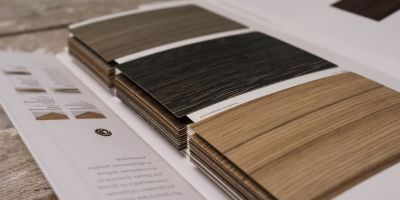
Walk into any commercial millwork shop or high-end residential job site today, and chances are you'll see two species dominating the assembly bench: White Oak and American Black Walnut. They are the undeniable heavyweights of modern interior design, driving the vast majority of custom cabinetry, architectural wall paneling, and statement furniture specs.
While both woods command respect on the shop floor, they sit on completely opposite ends of the visual spectrum. Choosing between them isn't just about picking between "light wood" or "dark wood"—it sets the entire tone, light reflectivity, and architectural feel of a space.
Here is a practical, shop-floor comparison of White Oak veneer sheets and Walnut veneer sheets to help you specify the right material for your next build.
White Oak: The Foundation of Contemporary & Organic Modern
If you are building for a Scandinavian-inspired, modern organic, or minimalist space, White Oak is the undisputed industry standard. It brings a bright, grounded neutrality to a room without feeling sterile.
Color Palette & Visual Impact
Raw White Oak ranges from pale wheat and cool beige to warm tan undertones. Unlike Red Oak, which carries distinct pinkish hues, White Oak offers a much cooler, more neutral palette. This neutrality makes it exceptionally versatile when pairing with polished concrete, matte black hardware, or muted earth-tone paint finishes.
Grain Structure & Cut Variations
The real magic of White Oak comes down to how the log is sliced. Depending on the cut specified for your backed veneer sheets, the visual language changes dramatically:
- Rift-Sawn White Oak: Sliced at a specific angle to produce a hyper-consistent, tight, pencil-straight linear grain. Rift-cut oak is the absolute darling of modern architecture because its straight lines don't fight the clean geometry of slab cabinet doors or full-height wall panels.
- Quarter-Sawn Flakey White Oak Sheets: Sliced perpendicular to the growth rings, revealing subtle, iridescent ray flecks (medullary rays) running across the linear grain. It adds textural interest and vintage character while maintaining structural linearity.
- Plain-Sliced (Flat-Cut) Sheets: Features traditional cathedral arch patterns. It offers a more rustic, familiar grain flow that works exceptionally well in transitional or modern farmhouse spaces.
Best Applications for White Oak: Seamless modern slab cabinetry runs, bright commercial office reception panels, perimeter retail fixtures, and open-concept residential wall cladding.
Walnut: Mid-Century Warmth & High-End Luxury
When a client or designer wants a space to immediately communicate warmth, elegance, and high-end craftsmanship, American Black Walnut is the go-to choice. It has been the benchmark of luxury woodworking for centuries, most famously anchoring the iconic Mid-Century Modern aesthetic of the 1950s and 60s.
Color Palette & Visual Impact
Walnut is famous for its rich, complex chocolate tones. It blends dark cocoa hues with warm amber highlights and, occasionally, soft purplish undertones. Because it absorbs light rather than reflecting it, a dark walnut installation instantly grounds a room, making large spaces feel cozy, intimate, and sophisticated.
Grain Structure & Movement
Unlike the tight linear consistency of rift white oak, Walnut is prized for its dramatic, organic movement.
- Plain-Sliced (Flat-Cut) Walnut Sheets: Showcases sweeping, fluid cathedral patterns and wavy grain lines. When sequence-matched across a wide credenza or wall paneling run, flat-cut walnut creates a mesmerizing, continuous ribbon of grain that acts as standalone art.
- Quartered / Rift Walnut Sheets: For spaces where cathedral movement is too busy, quartered walnut tones down the drama into clean, vertical chocolate stripes while retaining the species' signature color depth.
Best Applications for Walnut: Executive boardroom tables, custom residential library built-ins, luxury kitchen islands, high-end furniture reproductions, and moody, rich accent walls.
Head-to-Head Bench Comparison
|
Feature |
White Oak Veneer Sheets |
Walnut Veneer Sheets |
|
Primary Color Spectrum |
Cool tan, light wheat, neutral beige |
Deep chocolate brown, dark cocoa, amber |
|
Light Characteristics |
High reflectivity; brightens dark spaces |
Light-absorbing; adds weight and warmth |
|
Signature Grain Pattern |
Straight linear lines (Rift) or ray flecks (Quartered) |
Sweeping cathedrals and soft, fluid waves |
|
Design Vibe |
Minimalist, Scandinavian, Organic Modern |
Mid-Century Modern, Executive, Timeless Luxury |
|
Finishing Sensitivity |
Prone to yellowing with traditional oil finishes |
Fades under direct UV/sunlight over long periods |
Fabricator's Guide: Finishing & Handling on the Bench
Whether you are pressing paper-backed sheets or 2-ply wood-on-wood veneer (WOW), each species requires a slightly different touch in the finishing room:
Finishing White Oak
- Avoid Ambering Oils: Standard oil-based urethanes will turn bright White Oak an unpleasant, brassy orange over time.
- Use Water-Borne or Non-Yellowing Coatings: To maintain that raw, pale, Scandinavian look, apply a dead-flat water-borne acrylic or a non-yellowing conversion varnish. Adding a microscopic drop of white pigment or a dedicated "raw wood" sealer keeps the oak from darkening when the wet coat hits the face.
Finishing Walnut
- Feed the Grain Depth: Walnut loves clear topcoats. A clear conversion varnish or quality polyurethane highlights the natural chatoyancy (the optical depth) of the wood fibers without needing any artificial stains.
- Mind the Sapwood: Natural walnut trees contain bright, cream-colored sapwood near the outer bark. When buying premium backed walnut sheets, ensure you are sourcing heartwood-matched stock so your panel runs remain uniformly dark from edge to edge.
The Shop Bottom Line
You can't go wrong with either species, but specifying the right one comes down to the spatial goal of the build:
- Specify White Oak when: You need to open up a room, maximize natural light, and maintain clean, linear, unpretentious geometry across large surface areas.
- Specify Walnut when: You want to make a bold, sophisticated statement, create contrast against light countertops or walls, and embrace the rich, organic movement of natural timber grain.