

When I ask ten homeowners what "veneer" means, and at least half of them will tell you it's cheap, fake wood or printed plastic stapled onto particleboard. That single misconception causes more confusion in custom woodworking than almost anything else.
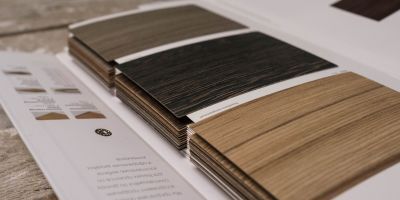
To put it simply: wood veneer is 100% real wood. It is produced by precision-slicing a natural hardwood log into micro-thin sheets—typically around 1/42" thick in North America—and bonding those sheets to a stable core substrate like MDF, Baltic birch, or particleboard.
Whether you're explaining material choices to a client or specifying sheets for a custom furniture build, understanding the definition of veneer, how raw logs are processed, and how backing layers function is fundamental to modern cabinetmaking. Here is your complete bench-side primer on hardwood veneer sheets.
The Log-to-Sheet Process: How Wood Veneer is Made
Instead of feeding a prime hardwood log into a saw mill and turning 30% of the tree into saw dust, veneer manufacturing maximizes every square inch of the timber. That yield efficiency makes eco friendly wood veneer one of the most sustainable surface materials in the building industry.
Veneer is produced using three primary slicing methods, each yielding a distinct visual face:
- Plain Sliced (Flat Cut): The log half is mounted on a machine bed and sliced parallel to the center line. This creates the classic, flowing cathedral arch grain pattern seen on traditional cabinetry.
- Quarter Sawn: The log is quartered and sliced perpendicular to the annual growth rings. This produces a straight, vertical grain line. In species like White Oak, it exposes flecks of medullary ray figure.
- Rift Sawn: Sliced at a slight angle ($15^\circ$ off perpendicular) to eliminate ray flecks, leaving a hyper-consistent, pencil-straight linear grain prized in modern architecture.
- Rotary Cut: The log is mounted on a center lathe and turned continuously against a blade, peeling off a wide, ribbon-like sheet. This produces a wide, wild, rustic grain pattern used primarily for utility plywood or paint-grade backing.
Anatomy of a Veneer Sheet: Backing Options Explained
Raw, unbacked wood flitches are fragile. To make veneers wood usable on a press or workbench, manufacturers permanently bond the thin wood face to a functional backing substrate at the mill.
|
Sheet Backing Type |
Core Characteristics |
Primary Shop Use |
|
10-Mil / 20-Mil Paper-Backed |
Flexible paper substrate bonded to the face. Prevents wood splitting during storage. |
Custom curved panels, face frame refacing, general casework. |
|
2-Ply (Wood-on-Wood) |
Features a secondary utility wood backer glued perpendicular to the face. |
Maximum rigidity; blocks core telegraphing on uneven surfaces. |
|
Phenolic-Backed |
Resin-impregnated paper backer creating a non-porous moisture barrier. |
High-gloss paint jobs, lacquer finishes, wet-process shop glue-ups. |
|
Peel and Stick Wood Veneer (PSA) |
Factory-applied 3M pressure-sensitive adhesive film behind a paper backer. |
On-site cabinet refacing, rapid repairs, DIY installations with no glue press. |
Solid Wood vs. Wood Veneer Furniture: The Practical Truth
There is a persistent myth that solid wood furniture is always superior to veneer wood furniture. I always tell people solid timber is great for table legs, door stiles, and structural posts, using solid hardwood for large flat surfaces (like conference table tops or full-height wall panels) is often a design mistake.
- Movement & Warping: Solid wood constantly expands and contracts across its grain as shop humidity changes. A 4-foot-wide solid wood tabletop can shift by up to $1/2$ inch across seasons, leading to split seams, cupping, and stuck drawers.
- Dimensional Stability: Because veneer sheets are bonded to an engineered core like MDF, the cross-grained substrate holds the face locked dead-flat. It won't warp, twist, or check under seasonal humidity shifts.
- Rare Grain Availability: Exotic figures—like burls, crotch walnut, or intense birdseye maple—are naturally brittle and physically impossible to work as thick, solid lumber planks. Veneer sheets are the only way to utilize these rare figures safely on large panel runs.
Essential Terms for Specifying Veneer
When ordering material from a supplier or reading an architectural spec sheet, keep these basic industry terms handy:
Flitch: A stacked bundle of consecutive veneer sheets sliced from the exact same log, arranged in the order they were cut to preserve grain sequence.
Book Match: Turning every other sheet over like pages in a book so adjacent edges match like a mirror image at the joint line.
Slip Match: Sliding sheets side-by-side without flipping them, keeping the orientation consistent across the panel for a uniform linear grain look.
Substrate: The structural core board (MDF, particleboard, or plywood) that face veneer sheets are pressed onto.
The Shop Bottom Line
When you understand what wood veneer actually is—real timber engineered for stability and maximum yield—helps you specify better materials, educate clients with confidence, and build flat, flawless casework that stands the test of time.