

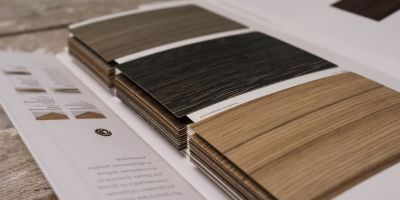
When an architect specs "Rift White Oak" for a $200,000 kitchen, they aren't just paying for the wood species—they are paying for the geometry of the cut. The way a log is oriented to the blade determines whether the veneer looks "busy" and cathedral-like or "quiet" and linear. Understanding these cuts is the difference between a project that looks like "lumber" and a project that looks like "architecture."
1. Plain Sliced (Flat Cut): The Cathedral Look
Plain slicing is the most common method for producing wood veneer sheets. The log is sliced parallel to a line through the center of the log.
- The Look: This produces a "cathedral" grain—those beautiful, looping arches in the center of the sheet with straighter grain on the edges.
- The Use Case: Best for traditional furniture where you want the "woodiness" of the tree to be the star. It is also the most economical cut because it produces the least amount of waste.
- The Downside: Plain sliced veneer has the most "internal tension" and is the most likely to move with humidity changes.
2. Quarter Sliced: The Flake and the Ribbon
To produce quartered veneer, the log is cut into quarters before slicing. The blade hits the growth rings at a 90-degree angle.
- The Look: This creates a series of straight, parallel lines. In White Oak and Red Oak, this cut also exposes the "medullary rays" of the tree, creating what we call "Flake" or "Tiger" grain.
- The Use Case: Essential for Arts and Crafts or Mission-style furniture. In species like Mahogany, it creates a "ribbon" effect that has a shimmering, 3D quality.
3. Rift Cut: The Modern Designer’s Choice
Rift cutting is unique to Oaks. The log is rotated during the slicing process to avoid the medullary rays entirely.
- The Look: The result is a straight, tight, linear grain without any of the "flake" found in quartered wood. It is the "quietest" grain possible. It can also have slight swings in the grain.
- The Use Case: High-end modern cabinetry. If a client wants a "minimalist" look where the wood doesn't distract from the clean lines of the kitchen, Rift White Oak is the only answer.
- The Cost: Because this cut produces the most waste and requires the most labor to rotate the log, it is the most expensive cut.
Stability and Sequence: How Geometry Affects the Shop
Beyond aesthetics, the cut affects how you work the wood.
- Expansion: Plain sliced veneer expands significantly more across its width than Rift or Quartered veneer. If you are doing a large-scale wall paneling job, Rift-cut sheets will stay more stable during seasonal shifts.
- Sequence Matching: Because Rift and Quartered sheets are sliced from a smaller portion of the log, the "sequences" (the number of sheets that look identical) are typically shorter than in a massive Plain Sliced log.
Conclusion: Matching the Cut to the Client
At Oakwood Veneer, we maintain an inventory of over 400 species, but more importantly, we stock them in various cuts. Choosing between a Plain Sliced Walnut and a Quartered Walnut isn't just a budget decision—it's a design decision. One feels rustic and organic; the other feels structured and sophisticated.
Need a specific look for a project?
Whether you are looking for the "quiet" lines of Rift White Oak or the "loud" cathedrals of Plain Sliced Cherry, our team can help you select the exact sequence for your shop. Call us at 800-426-6018 to talk through your grain requirements.