

If you’ve spent any time tracking residential or commercial design trends lately, you already know that the bright, ultra-clean Scandinavian aesthetic isn't going anywhere. Architects and clients can't get enough of those wide-open, minimalist spaces filled with natural light and pale wood tones.
But here is the hard truth from one shop guy to another: minimalist designs are the most unforgiving projects you will ever build.
When you are building a traditional, rustic kitchen with dark stains, you can hide a lot of minor variations in the wood. But when a project calls for a dead-consistent, bright, natural finish across twenty consecutive slab cabinet doors, there is nowhere to hide. If your wood tones don't match perfectly, the whole job looks like a patchy, mismatched mess.
If you want to pull off this look successfully, your best weapon in the rack is premium white maple veneer. However, handling maple isn't like handling walnut or oak. To get flawless results across a large installation, you need to understand how this unique wood is graded, sliced, and specified.
Flipping the Rules: Why White Maple is Unique
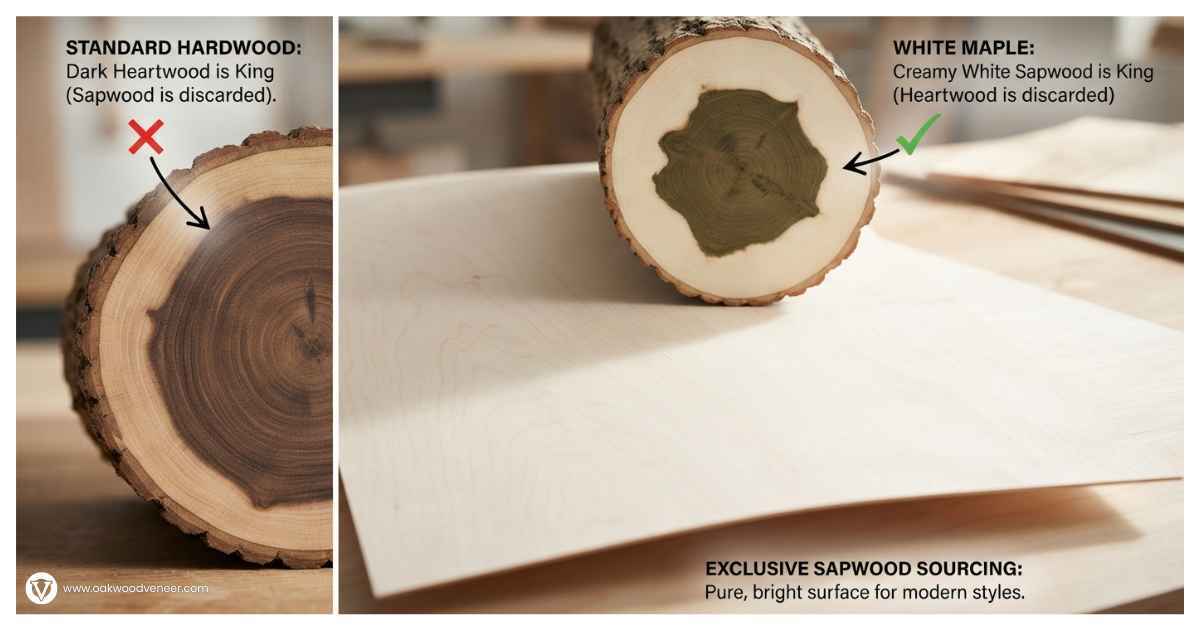
With almost every other hardwood log that passes through a mill—whether it's walnut, cherry, or oak—the prize is the heartwood. The heartwood is the dark, dense center of the tree that gives the species its signature color. The outer ring, called the sapwood, is usually cut away and tossed because it’s too light.
With white maple wood veneer, the rules are completely inverted.
The heartwood of a maple tree is actually a dark, muddy greenish-brown. If that heartwood makes its way onto a panel, it ruins the clean, bright look required for modern styles. Instead, premium white maple veneer sheets are sourced exclusively from the creamy white outer sapwood.
When you get a high-grade sap-maple log, it delivers an incredibly bright, dense, and fine-textured surface. It reflects natural light beautifully and features soft, subtle grain patterns rather than the heavy, aggressive cathedral lines common to coarser hardwoods like ash or oak.
How to Maintain Color Consistency on Large Builds
Because maple sapwood zones are relatively narrow compared to the core of the tree, keeping the color uniform across a massive run of panels takes some strategy. Here is how to protect your shop from patchy color variations.
1. Always Order Sequence-Matched Sheets
Never buy random, mismatched maple wood sheets off the rack for a large project. If you are building a continuous run of cabinetry or architectural wall panels, you need to specify sequence-matched maple wood veneer sheets. This ensures that every sheet you press comes from the exact same log flitch, keeping the color values and grain structures identical from left to right.
2. Choose the Right Slicing Technique
The way the mill cuts the log determines the final look of your maple sheet veneer:
- Maple Flat Cut (Plain Sliced): Gives you a broader, more traditional look with soft, rolling arches. It looks great on furniture but offers slightly more grain variation across wide layouts.
- Quarter Sawn Maple Veneer: The log is cut at a 90-degree angle to the growth rings. This produces a dead-straight, tight, linear grain pattern. If your client wants the ultimate minimalist look with absolute geometric consistency, quarter-sawn is the way to go.
3. Watch Out for "Sugar Tracks" and Mineral Streaks
Even in the highest-grade sapwood, maple trees occasionally pull up minerals from the soil, leaving small dark lines or tiny amber spots known as sugar tracks. In a rustic build, these add character. In a stark, Scandinavian design, they stick out like a sore thumb. When ordering your material, make sure you communicate clearly with your supplier that you are shooting for a clean, architectural-grade sap-face with minimal mineral characteristics.
Best Applications for Premium White Maple Veneer
When specified correctly, this species brings a high-end, spacious feel to a variety of custom wood projects:
- Modern Slab-Front Kitchens: Using flat-cut or quarter-sawn sequences across large, flat cabinet faces creates a seamless, monolithic look that defines modern Nordic kitchens.
- Retail Display Fixtures: White maple provides a bright, neutral backdrop that makes merchandise pop without clashing with interior branding colors.
- Interior Drawer Box Linings: Sliding open a dark cabinet to find a bright, glass-smooth maple-veneered drawer interior is a classic hallmark of high-end custom millwork.
- Commercial Wall Panels: Ideal for expansive corporate offices or hospitality lobbies where you want the warmth of real wood without darkening the room.
The Shop Bottom Line
Don't let bright, minimalist specs scare you away from bidding on high-end modern jobs. Achieving that flawless Scandinavian look just comes down to knowing your materials before you fire up the press.
By bypassing the dark heartwood, selecting sap-only sequences, and picking the right grain cut, you can deliver a project that looks clean, expansive, and perfectly uniform. When a client wants a space that feels light and effortless, step up to a premium white maple veneer and let the natural beauty of the sapwood do the heavy lifting for you.